About
Professor V. Krishnappa’s teaching, research, and public writing are situated at the intersection of philosophy, literature, ethics, liberal education, and the arts of reading. His central academic concern is the practice of reading as a formative mode of sensemaking: a way of cultivating attention, judgement, ethical imagination, and interpretive flexibility in conditions of complexity, ambiguity, and uncertainty. His work brings together philosophy and literature as disciplines of disorientation and renewal, with a particular interest in Wittgenstein, Karl Weick, Roland Barthes, Tolstoy, Dostoevsky, Nietzsche, Gandhi, and other thinkers for whom thought is inseparable from form, life, and ethical seriousness.
His research interests extend across Ancient Greek philosophy, Continental philosophy, ethics, philosophy as a way of life, literary theory, liberal arts pedagogy, critical thinking, Russian literature, Gandhi studies, and the philosophy of organising. He is especially interested in how literary and philosophical texts train readers to notice, pause, reorient, and make sense of difficult situations. In both his teaching and writing, he approaches reading not merely as interpretation or information-gathering, but as an apprenticeship in attention, self-formation, civic responsibility, and practical wisdom.
Widely published in major media outlets, Professor Krishnappa writes on philosophy, liberal education, critical thinking, Gandhi, artificial intelligence, and the future of the humanities. He is currently working on a book titled Reading Otherwise: Pedagogies of Sensemaking in Fiction and Life, which argues that literature and philosophy can train readers for uncertainty, complexity, and the unfinished character of human judgement.
Before joining RV University, Professor Krishnappa was a Doctoral Research Fellow in Philosophy and Literature at O.P. Jindal Global University from 2015 to 2021. His earlier academic training includes a PGDip in Strategy and Innovation from the Saïd Business School, University of Oxford; an MSc in Defence and Strategic Studies from the University of Madras; a certificate in Business Management from IIM Ahmedabad; and training in Peace Research at the University of Oslo.
Professor Krishnappa has close to four decades of professional experience, including over two decades devoted to teaching, research, institution-building, and public intellectual engagement. He previously served as a Research Fellow at the Institute for Defence Studies and Analyses, where he led major international and interdisciplinary projects. Prior to his academic career, he served in the Indian Air Force from 1986 to 2004, retiring with the rank of Group Captain, Select Grade.
Across his trajectory—from the cockpit to the classroom—Professor Krishnappa’s enduring concern has been with how human beings make sense of complex worlds.
Krishnappa Venkatshamy (2013)
The Indian Ocean Region in India's Strategic Futures: Looking Out to 2030, Journal of the Indian Ocean Region, 9:1,17-41
Krishnappa Venkatshamy (2012):
The Problem of Grand Strategy, Journal of Defence Studies, 6:3, 113-128
V. Krishnappa (2007)
Who Won the Second Israel–Lebanon War?, Strategic Analysis, 31:1 49-71
V. Krishnappa
“The Second Israel–Lebanon War: An Appraisal”, Asian Strategic Review, Academic Foundation, New Delhi (2007)
Krishnappa Venkataswamy
“Sustainability and India's Grand Strategy 2020 and Beyond”, in Michael J. Fratantuono et. al., US Army War College, 351-400 (2017)
India’s Grand Strategy
History, Theory, Cases, Routledge (New Delhi/London), 2014, 2019 (Edited with Kanti Bajpai and Saira Basit)
India’s Grand Strategy
2020 and Beyond, Pentagon Press (New Delhi), 2012 (Edited with Princy George)
The Global Power Shifts and Strategic Transition in Asia
Academic Foundation (New Delhi), 2009 (Edited with N.S. Sisodia)
Philosophy in the age of AI
Philosophy in the age of AI, Deccan Herald, 07 Sep 2025,
Link: https://www.deccanherald.com/opinion/philosophy-in-the-age-of-ai-3716476
Demystifying liberal arts education
Demystifying liberal arts education, Deccan Herald, 07 Nov 2023
Link: https://www.deccanherald.com/education/demystifying-liberal-arts-education-2759269
Philosophy in the age of AI
Demystifying liberal arts education
Gandhi and the Future of Slow Philosophy
Why study philosophy?
Liberal arts difference
The Importance of Cultivating Critical Thinking in Liberal Arts Education
Seven liberal arts traits for India’s future
Professor Krishnappa’s work explores reading as sensemaking and sensemaking as reading, treating them as formative practices for living and acting in an uncertain world. For him, literature and philosophy are not simply objects of study but exercises in attention, ethical imagination, and interpretive flexibility—the very qualities that shape professional practice in complex environments. In his teaching and research, he invites students to see reading otherwise as a pedagogy of sensemaking, one that prepares them for judgement, responsibility, and creativity in their personal, professional, and civic lives. Drawing on Wittgenstein, Tolstoy, and Russian literature, alongside Continental philosophy, ethics, and critical epistemology, Professor Krishnappa illuminates how texts train us to make sense. His interests also extend to the philosophy of organising, scenario method, crisis leadership, and interdisciplinary approaches to complexity, where he shows how reading as sensemaking can serve as preparation for practice in uncertain times.
Prestigious educational / leadership programmes by organisations including Peace Research International Oslo (PRIO) and the United States Department of State
Government of the United Kingdom as a Young Leader for significant contributions made to chosen field in 2013
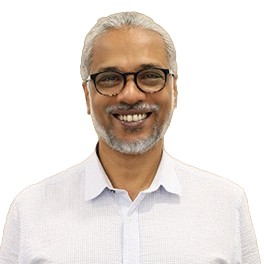
Professor of Liberal Studies, School of Liberal Arts and Sciences
School of Liberal Arts and Sciences
-
 Bengaluru
 Academics
 Admissions
 Faculty
 Enquire